
Refractive Surgery
Refractive surgery uses surgical or laser-based techniques to change the eye’s focusing system and correct certain refractive errors such as myopia, hyperopia and astigmatism. The most suitable procedure depends on individual eye measurements and overall eye health.
- Home
- Refractive Surgery
Glasses and contact lenses are effective ways to correct refractive errors, but some people prefer a longer-term vision-correction option. Refractive surgery may be suitable for selected patients who want to reduce their dependence on glasses or contact lenses.
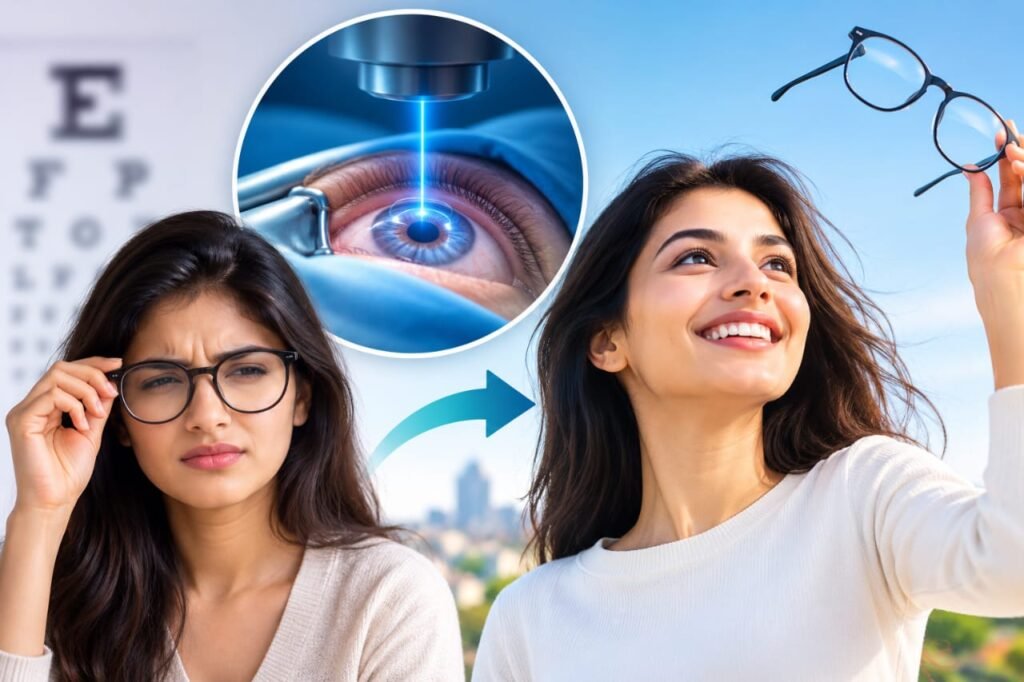
Refractive surgery is a group of procedures designed to change how light is focused by the eye. Depending on the patient’s eye health, corneal shape, prescription and age, an ophthalmologist may consider procedures such as LASIK, PRK, SMILE or phakic intraocular lenses.
At IISIGHT Charitable Eye Hospital, patients can undergo a detailed eye evaluation before discussing whether refractive surgery is appropriate for them. The aim is not simply to perform surgery, but to understand the patient’s visual needs, eye health and expectations before recommending a treatment option.
What Is Refractive Surgery?
Refractive surgery refers to procedures that modify the optical properties of the eye to reduce refractive errors.
Normally, light entering the eye should be focused precisely on the retina. If the shape or focusing power of the eye causes light to focus in front of or behind the retina, vision may appear blurred.
The main refractive errors are:
- Myopia (short-sightedness): Distant objects appear blurry.
- Hyperopia (long-sightedness): Near vision can be difficult, although symptoms vary.
- Astigmatism: An irregular curvature of the cornea or lens can cause distorted or blurred vision.
- Presbyopia: Age-related difficulty focusing on nearby objects.
Types of Refractive Eye Surgery
There are several types of refractive procedures. They are not interchangeable, and the option depends on the patient’s individual measurements
LASIK
LASIK is one of the most widely known laser vision-correction procedures.
It reshapes the cornea so that incoming light can be focused more accurately on the retina.
LASIK may be considered for suitable patients with myopia, hyperopia or astigmatism.
PRK
Photorefractive keratectomy (PRK) is another laser vision-correction procedure.
Because PRK does not involve creating a LASIK-style flap, it can be considered for some patients who may not be ideal candidates for LASIK.
However, surface healing takes longer than with LASIK, and visual recovery can be more gradual.
SMILE
Small Incision Lenticule Extraction (SMILE) is a minimally invasive corneal laser procedure.
A small incision is used to remove a lenticule created within the cornea.
SMILE is primarily used for suitable cases of myopia and astigmatism, depending on the technology, prescription and clinical assessment.
Phakic IOL / ICL
A phakic intraocular lens is placed inside the eye while the natural lens remains in place.
This can be an option for selected patients who are not suitable for corneal laser procedures or who have refractive errors outside the appropriate range for a particular laser technique.
The procedure involves intraocular surgery and therefore has a different risk profile from corneal laser procedures.
What Vision Problems Can Refractive Surgery Correct?
Depending on the procedure and individual suitability, refractive surgery may be used to correct:
Myopia
People with myopia generally have clearer near vision than distance vision without correction.
Hyperopia
Hyperopia can make near tasks difficult and may sometimes cause eye strain or blurred vision.
Astigmatism
Astigmatism occurs when the cornea or lens has an irregular shape, potentially causing blurred or distorted vision.
Presbyopia
Presbyopia is different from conventional refractive errors because it develops as the eye’s natural focusing ability decreases with age.
Some refractive strategies can address near-vision needs in selected patients, but expectations need to be discussed carefully.
Benefits & Risks of Refractive Surgery
Potential Benefits
For appropriately selected patients, refractive surgery may:
- Reduce dependence on spectacles.
- Reduce dependence on contact lenses.
- Improve unaided distance vision.
- Make everyday activities more convenient.
- Provide an alternative to long-term corrective-lens use.
However, refractive surgery should not be viewed as a guarantee of perfect vision.
Possible Risks and Side Effects
Like any medical procedure, refractive surgery has potential risks.
These can include:
- Dry eye symptoms
- Glare
- Halos around lights
- Difficulty with night vision
- Fluctuating vision
- Undercorrection
- Overcorrection
- Residual refractive error
- Infection or inflammation
- Corneal complications
- Need for additional treatment in selected cases
Serious complications are uncommon, but they can occur.
When Should You Consider Refractive Surgery?
You may want to discuss refractive surgery if:
- You are tired of depending on glasses.
- Contact lenses cause discomfort.
- Your spectacle prescription has been stable.
- You participate in activities where glasses are inconvenient.
- You want to understand your options for reducing dependence on corrective lenses.
However, wanting to stop wearing glasses does not by itself mean you should have surgery.
The decision should be based on your eye measurements, health, lifestyle and expectations.
Book a Refractive Surgery Consultation in Mohali
IISIGHT Charitable Eye Hospital
📍 Address:
SCO 1066-67, Aerodale Market, Airport Road, beside Guru Estates, New Sunny Enclave, Sector 123, Sahibzada Ajit Singh Nagar, Punjab 140301
📞 Call: 8146893492
Opening Hours:
Monday–Saturday: 9:00 AM–7:00 PM
Sunday: 9:00 AM–2:00 PM